Energy justice advocates call on government to wipe growing energy debt
New AER data shows hundreds of thousands are struggling with rising energy debts as Australians demand more government intervention to lower bills.
An alliance of energy justice advocates is calling for urgent government intervention to wipe-out the energy debts of struggling households, as new data shows almost 1 in 20 energy consumers cannot cover the full cost of their regular energy bill, as energy companies’ profits continue to soar and the government considers another round of energy bill rebates. Meanwhile, new polling shows the Australian public is fed up with the profiteering of big energy companies and want the Australian government to intervene to lower bills.
Included below: comments from Sweltering Cities spokesperson Farah Chaar, Parents for Climate CEO, Nic Seton and Antipoverty Centre spokesperson Jay Coonan and background on new stats and polling.
New data from the Australian Energy Regulator, released as part of its annual market report, shows that
- 336,615 households were in energy debt last year – a slight increase of 1.4% on the previous year
- Almost 1 in 20 of all energy customers are in some form of energy debt.
- 121,759 households were part of official hardship programs, 39% of them have been in a program for more than 12 months. Of the 150,000 people who exited a hardship program last year 68% were discontinued because they were unable to meet their agreed payment plan and schedule – only 32% had paid off their debt.
- The average value of a household’s energy debt increased by $219 last year – to $1,367
- While the Federal Government’s rebates provided some relief to hardship customers and those with very small debts at the beginning of the year, these were much less impactful in the second half of the year when debts were higher.
Advocates say new AER data confirms what households already know: Australia’s energy price crisis continues to rage on, with more and more people struggling to pay their bills pushed into debt while big energy companies rake in billions of dollars in profit. The update comes as the federal government deliberates whether to renew the Energy Bill Relief Fund rebates for a third consecutive year. The Stop the Bill Shock coalition warns that rebates are not a substitute for fixing the system itself, and that energy debt is a political and corporate choice that governments can act on right now.
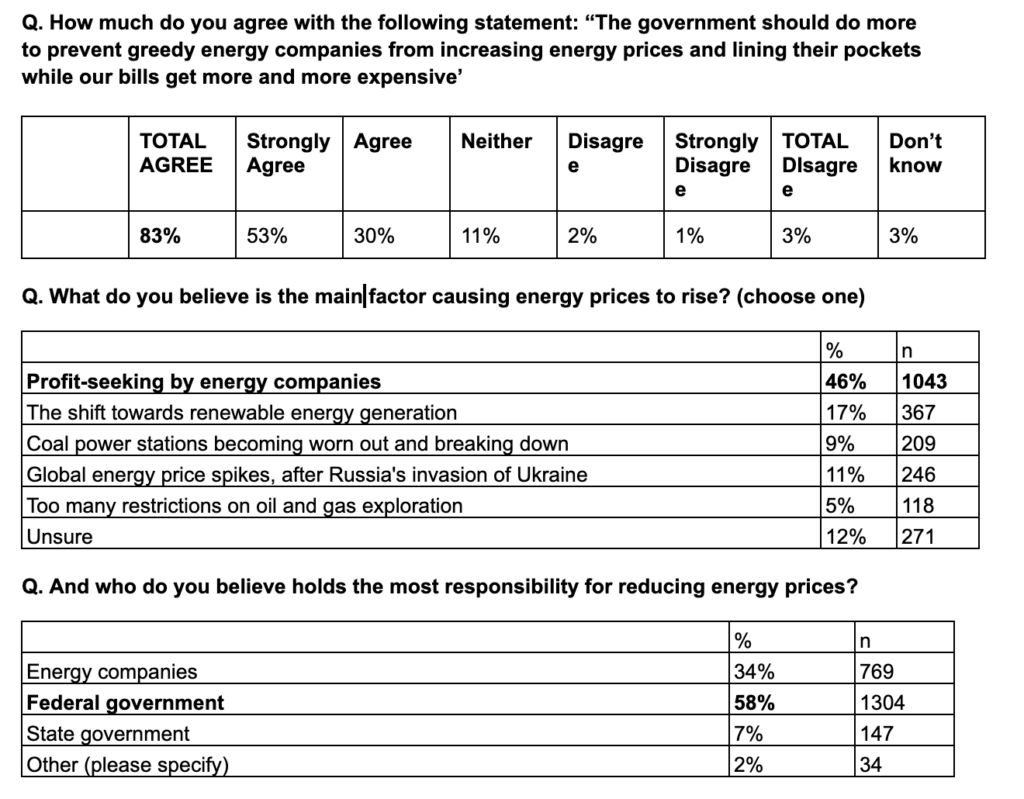
The report coincides with new national polling that shows about half of Australians blame profit-seeking energy companies for rising energy bills and want the government to take more action to stop bills from rising even further. The national poll, conducted in October, found:
- 46 percent of Australians say profit-seeking by energy companies is the leading reason energy prices keep rising.
- 83 percent of Australians want the federal government to take stronger action to bring bills down and rein in unfair pricing.
Quotes attributable to Antipoverty Centre spokesperson and DSP recipient Kristin O’Connell
“The government should be stepping in to stop energy retailers taking the piss. They’ve had it too good for too long and people are sick of paying through the nose while CEO’s make millions and shareholders make off with dividends.
“Energy retailers should be made to spend their billions on bringing down bills, instead of making billions by putting people into debt.”
Quotes attributable to Parents for Climate CEO, Nic Seton
“Parents are telling us they’re terrified about the heat this summer. Safe temperatures should be a basic right for every child, yet families are being priced out of staying safe at home while retailers record massive profits. It’s past time the government steps in to protect Australians who expect stronger action to stop profiteering and tackle the root causes of energy debt.”
Quotes attributable to Sweltering Cities spokesperson, Farah Chaar
“Energy costs have been keeping people in a cycle of having to choose between their health and their ability to pay the bills summer after summer. With another season of high temperatures and heatwave risks predicted, it’s time for urgent policy action to curb the cost of staying safe. The government’s own climate risk assessment proves it’s time to put community health first, not profits.”
Media contact: email media at antipovertycentre.org or call/message 0413 261 362 via Signal
Background: polling and key statistics
Click here to download Antipoverty Centre’s ‘Desperate for Relief’ snapshot that looked at the 2023/24 annual debt figures and retailer profits.
- Despite falling wholesale prices driven by renewable energy generation, Australia’s largest energy retailers have posted significant profit increases across FY24 and early FY25.
- AER data shows that energy debt is up $219 ($1,367 up from $1,148 in 2024) from last year as more people are stuck in debt long term. 39% of people struggling to pay their bills have been in a hardship program for more than 12 months, an 8% increase since last year.
- 50% of people in a hardship program are paying less than they use each bill cycle and over half the people in hardship are eligible for energy concessions, but are not receiving them.
- The amount of debt for people when they go into a hardship program has increased by $415 to $2,102, up from $1,687 at 30 June 2024.
- There has been a 35% increase to the number of people signing themselves up to hardship programs in the past year, and a 19% decrease of energy retailers signing customers up to hardship programs.
- Of the ~150,000 people who exited a hardship program in the past year 68% were exited for being unable to comply with the program, only 32% exited because they had completed the hardship plan.
- Regulation changes forcing retailers to offer lowest tariff to customers struggling to pay their bills won’t come into effect until December 2026, leaving energy retailers to justify using energy debt on their books to ask for price increases for everyone.
- The Stop the Bill Shock coalition includes Parents for Climate, Sweltering Cities, the Antipoverty Centre and partner organisations working to end energy poverty.
Polling questions
Methodology Statement
This study was commissioned by Renew Australia for All and conducted by the research firm 89 Degrees East as part of a larger poll with a total sample size of 4,711 Australians. Fieldwork was conducted by 89 Degrees East between Thursday 11 September and Tuesday 28 September 2025.
The sample included a nationally representative poll of 2,254 Australians, with an additional boost sample of 1,952 Australians residing in Renewable Energy Zones (REZs) across New South Wales, Victoria and Queensland.
The survey was administered online with recruitment sourced from a consumer opt-in panel provided by Pure Profile.
The confidence level of the general population sample is +/- 2.11% at the 95% confidence level.
89 Degrees East is a member of The Research Society of Australia and the Australian Polling Council.
About the Stop the Bill Shock
The Stop the Bill Shock campaign was started by a collective of climate and economic justice organisations working and campaigning to make sure energy bills are permanently lowered and that everyone benefits and is included in the transition to renewables – not just those that can afford home upgrades.
We have shared experience in our exposure to the worst effects of severe temperatures, which are increasing in their frequency and intensity as climate change accelerates. We know the people and communities affected by heat impacts and disasters are best placed to lead the solutions that are needed to create a climate safe future.
Our shared priority is to ensure every Australian has access to a climate safe home, and to protect people on the lowest incomes from the health impacts of severe temperatures as part of a fast, fair and sustainable transition to clean energy. Our solutions will deliver sustained cost of living relief for people who have been locked out of the benefits of rooftop solar, energy efficiency and electrification programs. We are seeking support for a range of complementary measures to build community resilience and deliver adequate shelter and safety for all.